
State College Resident Lookup Records
A State College resident lookup works best when each record answers one narrow question. Centre County assessment material can identify a tax owner of record and a parcel key. The Recorder connects document parties to a transfer history. Pennsylvania UJS Case Search can locate publicly visible docket information, while the Pennsylvania Room and vital-record custodians offer historical relationship or death leads. None is a complete household roster. A name, address, or mailing field must be weighed against the record’s purpose and date.
| Record | What It Confirms | Where | Access |
|---|---|---|---|
| Assessment parcel record | Tax owner of record, UPI, valuation and parcel context | Centre County Tax Assessment | DataScout subscription or public lobby terminal |
| Recorded deed chain | Transfer parties, recording dates and legal property links | Centre County Recorder of Deeds | Counter inspection from 1800 or paid WEBIA access |
| Public court docket | Public case, participant and event trail | Pennsylvania UJS Case Search | Free public search, with exclusions |
| Historic family records | Marriage, estate, obituary or death-event leads | Pennsylvania Room | Onsite indexes and staff research route |
| Vital record pathway | Eligible certified or historical birth and death evidence | Pennsylvania Vital Records | Eligibility rules and archival access periods apply |
Choose the channel that matches the question. A parcel question belongs with Assessment and the Recorder. A historic death or estate question belongs with the Pennsylvania Room, the Register of Wills, or the State Archives. For an individual’s own registration status, use the official voter-status route. The County’s free parcel viewer is useful first for map context, but it deliberately does not provide ownership data.
Verify a State College Resident
Use independent records to test a match, not to turn a loose name hit into a claim. State College and University Park mailing names can both appear in the same local geography, so retain the street number, municipality, mailing label, date range, and any parcel identifier. The Recorder’s special name-change mortgage workflow itself uses first, middle, and last names with date of birth, which shows why an unqualified name search can collide with someone else’s record. A tax mailing address can also differ from a property’s situs address.
- State the task in record terms, such as identifying the tax owner of record for a parcel on a stated date.
- Locate the parcel and its UPI through the Assessment route, then preserve the source date and the record’s owner-of-record limit.
- Use the UPI or legal description to compare the acquisition deed and prior transfer references at the Recorder.
- For a name-based court result, add Centre County, a date range, a middle name, or a docket number before treating it as the same person.
- When history matters, corroborate with a Pennsylvania Room obituary, estate, marriage, map, or released census source.
- Docket
- A court’s chronological case record, which may show parties, events and status but is not always the complete file.
- Index versus image
- An index points to a record through names, dates or identifiers. The original document image may be at the custodian, behind a subscription, or unavailable online.
- Certified copy
- A custodian-issued copy that is certified as a record. It can have separate identity, relationship, fee, and request rules.
Search State College UJS Dockets
Pennsylvania UJS Case Search is the free statewide starting point for publicly visible Court of Common Pleas and Magisterial District docket material. For State College, select Centre County where appropriate and use a participant name with a neutral second check, such as a known filing period or case number. The advanced interface exposes docket number, citation, filing-date range, county, judicial district, court office, participant last and first name, date of birth, case status, and address-related fields. It does not publish a universal starting year.
| UJS search field | Field type | State College use |
|---|---|---|
| Docket Number | Text | Use a known MDJS, Common Pleas, or appellate identifier. |
| Date Filed Start / End | Date pair | Narrow a name result by an approximate filing period. |
| County / Judicial District / MDJS Court Office | Dropdowns | Select Centre and the appropriate court geography when known. |
| Participant Last Name / First Name / Date of Birth | Text and date | Use the available neutral details to separate same-name results. |
| Docket Type / Case Category / Case Status | Dropdowns | Options are dynamically populated and should be checked live. |
| Parcel Address / City / State / ZIP | Text and dropdowns | Address-related fields appear in advanced search, but do not establish present residency. |
Open the Pennsylvania UJS Case Search interface to see the official search modes and field labels.
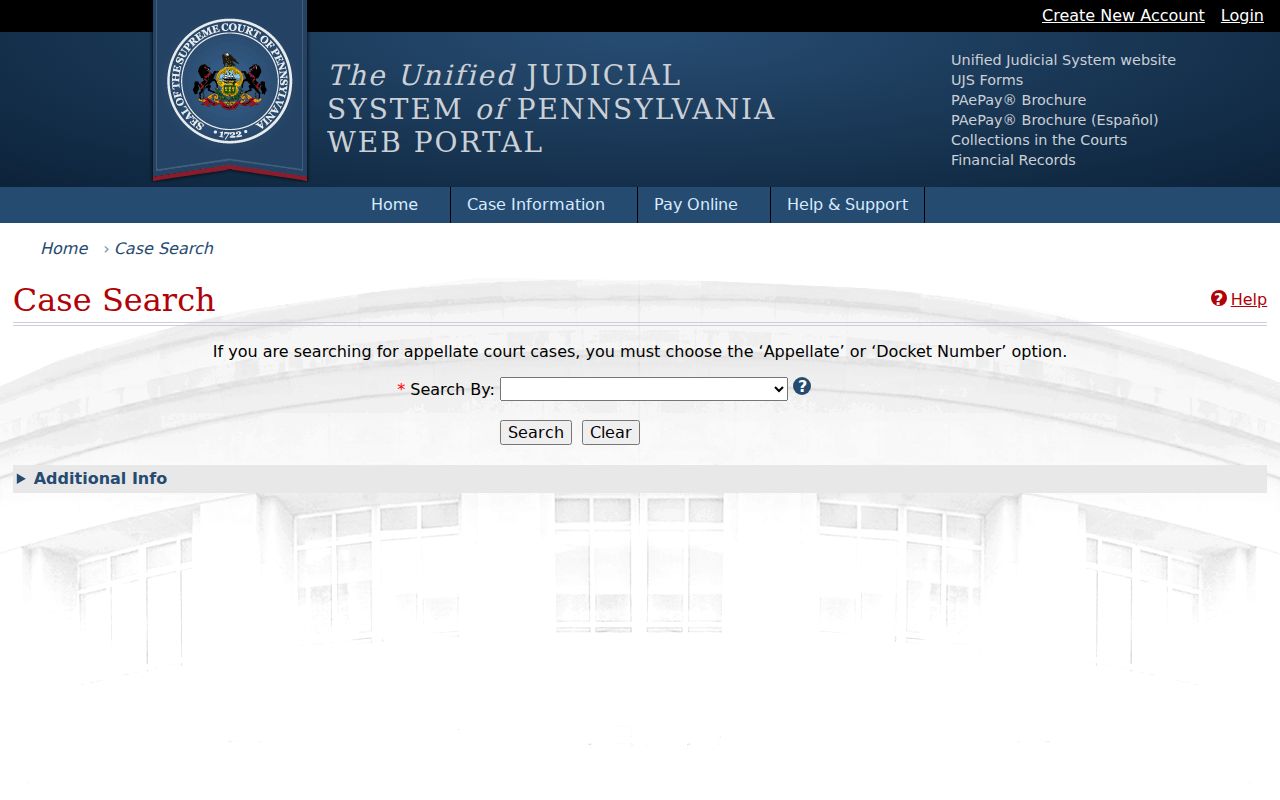
The interface supports a focused search, but a public result is not a finding about a person’s present address or conduct. Juvenile, expunged, limited-access, and some civil material can be absent, and recent filings can lag. For a full paper record or copy, contact the relevant court office instead of relying on the web docket alone.
The published public-docket inventory identifies the following result categories without opening a named record:
- Participant, organization, attorney, role, date-of-birth, and case-identifier dimensions.
- Docket number, citation, OTN, complaint or incident number, court office, and judicial district.
- Docket type, case category, case status, events, calendar fields, judge, and agency information where public.
- Portal exclusions, including juvenile, expunged, limited-access, certain civil, and disposed MDJS material.
State College precincts are assigned across several Magisterial District Judge offices. That local court geography makes a Centre County and court-office filter more reliable than a statewide name-only search. A docket address may be a service or mailing address, so it needs a separate property or historical-source check.
State College Vital Record Paths
Vital evidence divides by both event date and record type. Centre County’s Register of Wills holds local birth and death records for 1893 through 1905, while Pennsylvania’s Division of Vital Records handles births and deaths from 1906 forward. Historical public access is different from a current certified request: birth records become public after 105 years and death records after 50 years under the Vital Statistics Law of 1953. The State Archives provides the historical-copy route when a record is open.
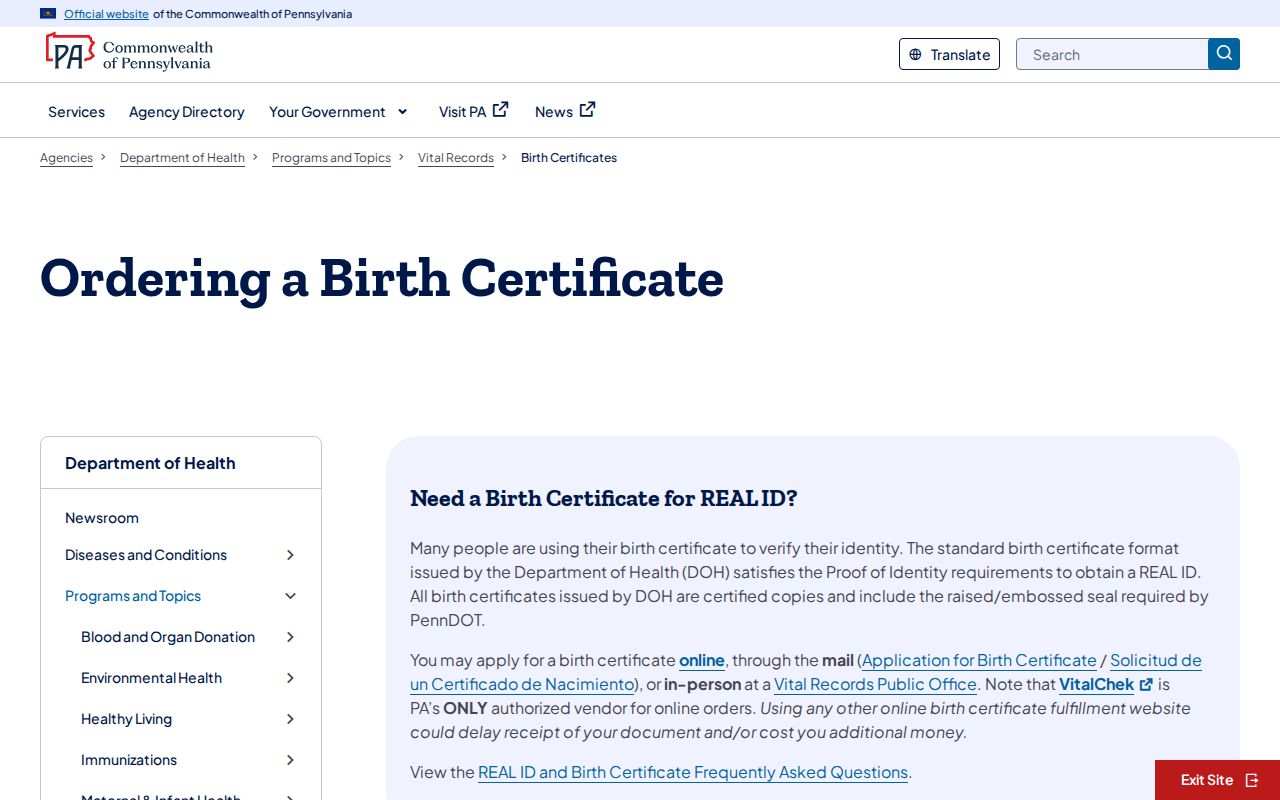
The Pennsylvania birth-certificate page describes the official online, mail, and in-person channels and the eligibility requirements for a current certificate.
For family-history research, the Pennsylvania Room adds Centre County birth and death indexes for 1893 through 1905, marriage-index material, obituary indexes, church records, cemetery series, and estate leads. Its records supply a traceable historical path without suggesting that a modern certificate is publicly available.
Note: A historical index can identify a lead, but the custodian’s access rules still control the original record and any certified copy.
State College Voter Record Rules
The official Pennsylvania Voter Registration Status route is for a person checking their own status or polling information, not a public browse-by-address tool. Centre County Elections also accepts its specific voter-information request form for reports and lists. The form offers a Street List, a Walking List, countywide material, or a special request, then requires identification and a signed affirmation. County delivery is stated as email with a five-day minimum turnaround.
Public voter material has a tight statutory boundary. Pennsylvania’s public-information list can include prescribed name, address, date-of-birth, voting-history, and district fields, but it excludes electronic signatures and SURE registration numbers. Street and walking lists are restricted to stated election, political-activity, or law-enforcement purposes and may not be posted online. That makes voter information unsuitable for a general resident lookup.
Open the Centre County Elections and Voter Registration office page for its current office contact and election resources. Verify any live request form before submitting it, because delivery details and form controls can change.
The official status form is the state’s designated route for an individual status check.
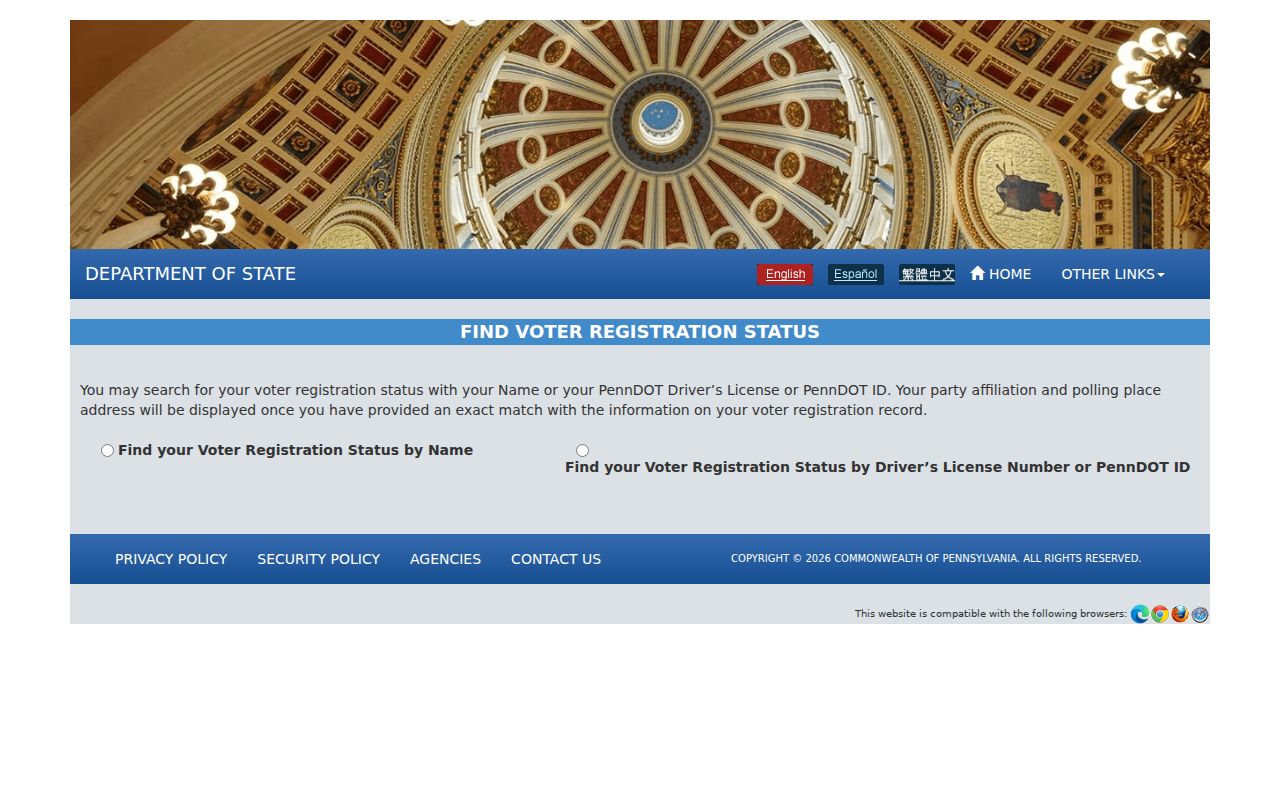
That form is a self-service confirmation channel, while the county request process is the documented route for the limited list types described above.
State College Estate Research Routes
For a family-history question, the Pennsylvania Room is a stronger local route than a generic name search. Its computerized obituary and death-notice index spans 1821 through 2021, and its probate and estate files span 1800 through 1990. Those sources can establish an executor, an heir lead, a death event, or a time frame. They do not prove that each named relative lived at a particular address, so pair an estate reference with the deed, tax, map, or obituary evidence that fits the question.
The Pennsylvania Room research service begins with a request form and a preliminary staff review. It can examine WebIA deed and tax material, cemetery and court records, maps, county histories, family histories, and clippings. Onsite researchers also have access to the room’s original records and selected databases. This is the practical fallback when an index points to a local record but the online interface stops.
A February 2025 library report says that 15,840 estate files and marriage books or applications from 1885 through 1990 were digitized with FamilySearch support. Preserve the actual record citation after finding an item, since a full-text search result is a starting point rather than a conclusion.
State College Offline Lookup Routes
When a portal does not answer a precise question, use the custodian that holds the record. The Recorder’s public documents are available for office inspection from 1800 forward, except military discharges, and remote WEBIA access is a paid subscription. Assessment records are available through the County’s lobby terminals or DataScout subscription. The Pennsylvania Room supplies onsite original records and paid staff research after its initial review. A targeted request should state the document, address or name variant, and date range sought.
For borough planning, public works, or other municipal material, use the State College Right-to-Know request process. Pennsylvania’s Right-to-Know Law, Act 3 of 2008, generally calls for a response within five business days, subject to the stated interim-response rules. A request asks for existing records. It does not require an agency to create a new list of people.
State College Protected Address Limits
Some missing results are correct results. Pennsylvania’s Address Confidentiality Program gives eligible participants a substitute mailing address for specified public records and renews every three years. Court dockets can omit protected categories, motor-vehicle data has separate federal limits, and adoption filings are confidential. Voter lists have their own statutory use and republication restrictions. If an official record is wrong, ask the office that keeps that record about its correction process rather than repeating the error elsewhere.
Lawful use. Use State College records for personal, lawful research and source verification. Threatening, repeatedly contacting, stalking, or harassing a person is prohibited and may violate Pennsylvania law.
Commercial people-search products are a separate category from official records. They can combine delayed, duplicate, or mismatched data, so they are not a substitute for checking the primary custodian. If a commercial listing displays personal data, use that publisher’s own privacy process; it cannot erase a lawful deed, tax record, or court record from the government custodian.